 San Pedro Sula Mayan Ruins
Is San Pedro Sula Safe? What the Travel Advisories Say
Is San Pedro Sula safe for the traveller heading to Copán or Lake Yojoa? This page compares what the US, UK and Canadian governments actually say about the city, then sets out the practical steps each advisory gives. The short version is that the city carries real risk and the advisories name specific neighbourhoods to avoid, while the Copán and Lake Yojoa day trips run hotel to site in the operator's vehicle. You can compare the tours from San Pedro Sula, side by side alongside this safety guide before you book.
Quick answer The short answer
The US State Department rates Honduras at Level 3, Reconsider Travel, because of crime, and its advisory names San Pedro Sula as a place where high levels of crime and violence are prevalent. The UK Foreign Office and the Canadian government both advise a high degree of caution across Honduras and both tell travellers to avoid non-essential travel to named eastern neighbourhoods of San Pedro Sula. In practice, visitors on the tours from San Pedro Sula, side by side travel between the hotel and the site in the operator's vehicle, with pickup and drop-off at the hotel. For the rest of your stay the advisories are specific: use radio-dispatched or hotel taxis, do not walk around the city, and avoid road travel at night.
Key takeaways
- The US advisory is Level 3, Reconsider Travel, for Honduras nationwide, with San Pedro Sula named for crime and violence. See the advisory comparison.
- The UK and Canada name Chamalecón, Cofradía and Rivera Hernandez among the areas to avoid. Details in the neighbourhood lists.
- The day trips on this site use hotel pickup and the operator's own vehicle. Compare the Copán day trips or read the route guide for San Pedro Sula to Copán.
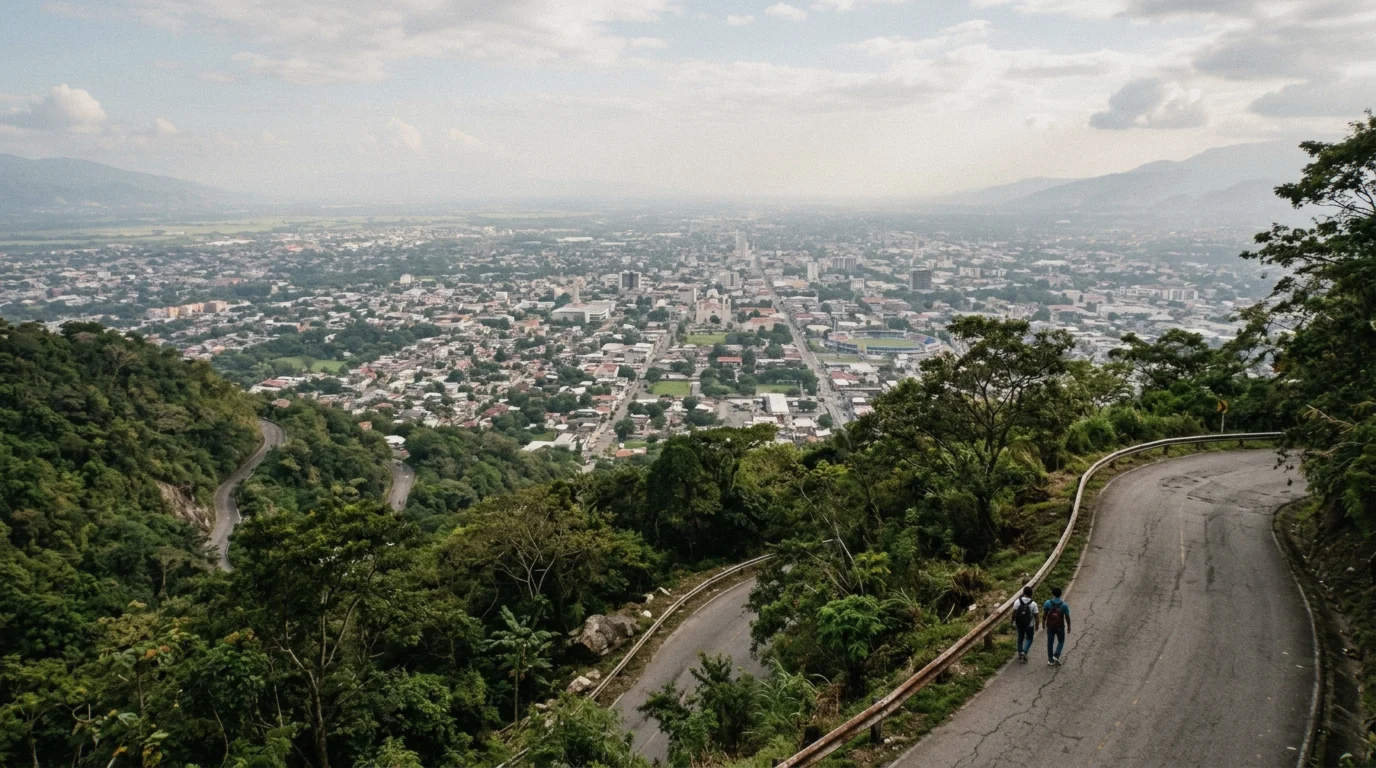
The city across the Sula Valley.
Travel Advisories for San Pedro Sula Compared
Three governments publish formal advice for Honduras. Here is what each says about the country as a whole and about San Pedro Sula in particular.
What each government says
The three advisories use different scales but point the same way. The United States gives the bluntest country rating at Level 3. The United Kingdom and Canada use the gentler phrase high degree of caution, but both add a stricter regional instruction for parts of San Pedro Sula itself, telling travellers to avoid non-essential travel there.
One point of caution. The US advisory text retrieved for this page confirmed the Level 3 country rating and its general crime language, but the fine detail of department-level restrictions could not be directly verified from the State Department site itself. Do not assume the US has a separate rating for San Pedro Sula beyond what is shown here. Advisories also change, sometimes several times a year. Read the live pages on the official sites before you fly.
| Government | Level for Honduras | What it says about San Pedro Sula |
|---|---|---|
| United States (State Department) | Level 3: Reconsider Travel, due to crime | Names San Pedro Sula and Tegucigalpa as places where high levels of crime and violence are prevalent and where the security situation poses a risk for foreigners |
| United Kingdom (FCDO) | High degree of caution nationwide | Advises against non-essential travel to parts of the city, naming Chamalecón, Cofradía and Rivera Hernandez |
| Canada (Government of Canada) | Exercise a high degree of caution nationwide | Regional avoid non-essential travel for named eastern neighbourhoods of San Pedro Sula and for Choloma |
Sources: US Department of State Travel Advisory, UK FCDO travel advice, Government of Canada travel advice
Crime Figures in Context
Numbers help size the risk. Here are the main published figures, with their sources, and the honest gaps in what anyone publishes.
The national homicide rate
Two organisations publish national homicide figures for Honduras and they disagree slightly, because they use different methods. InSight Crime reports 2,332 murders in 2025 for a rate of 23.2 per 100,000 people, down from 25.3 per 100,000 in 2024. The Observatorio de la Violencia at the National Autonomous University of Honduras put 2025 at a preliminary 26.6 per 100,000, pending its official year-end report. Both agree on the direction. The rate has fallen for six consecutive years. Both also agree that Honduras remains one of the most violent countries in the world and the most homicidal in Central America.
For the city itself, the Observatorio reported 166 homicides in San Pedro Sula in 2024, which made it one of the two departmental capitals with the highest counts, alongside Tegucigalpa at 256. No official source publishes a current per-100,000 rate for the city, so none is given here.
| Measure | Figure | Source |
|---|---|---|
| National homicide rate, 2025 | 23.2 per 100,000 | InSight Crime, 2025 Homicide Round-Up |
| National homicide rate, 2024 | 25.3 per 100,000 | InSight Crime, 2025 Homicide Round-Up |
| National homicide rate, 2025 (preliminary) | 26.6 per 100,000 | Observatorio de la Violencia, IUDPAS-UNAH |
| Homicides in San Pedro Sula, 2024 | 166 | Observatorio Nacional de la Violencia, IUDPAS-UNAH |
| Homicides in Tegucigalpa, 2024 | 256 | Observatorio Nacional de la Violencia, IUDPAS-UNAH |
How to read this
A national rate of roughly 23 to 27 per 100,000 is high by almost any global standard, so the advisories are not being alarmist. What the numbers do not tell you is your personal risk as a short-term visitor who sleeps in a hotel and travels by private vehicle to Copán or Lake Yojoa. No official source publishes a victim profile that would answer that question directly.
The practical takeaway is the one the advisories give. The violence is real, much of it is gang related, and the sensible response is to limit your exposure rather than to treat the whole country as uniformly dangerous.
Sources: InSight Crime, 2025 Homicide Round-Up, Observatorio de la Violencia, IUDPAS-UNAH
Areas the Advisories Name
Both the UK and Canadian advisories draw their map of San Pedro Sula the same way. The named areas sit in the east of the city.
Avoid non-essential travel areas
The UK FCDO names Chamalecón, Cofradía and Rivera Hernandez as eastern San Pedro Sula neighbourhoods to avoid, citing gang activity and violent crime. It adds the city of Choloma and the El Planeta neighbourhood in La Lima to the same list. Canada's advisory names exactly the same places, with Choloma included, under a regional avoid non-essential travel instruction.
The US advisory does not list neighbourhoods. It names the city as a whole, alongside Tegucigalpa, as a place where crime and violence are prevalent and where the security situation poses a risk for foreigners. None of the three advisories publishes a list of recommended neighbourhoods, so this page cannot either.
| Area | Named by | Reason given |
|---|---|---|
| Chamalecón (eastern San Pedro Sula) | UK and Canada | Gang activity and violent crime |
| Cofradía (eastern San Pedro Sula) | UK and Canada | Gang activity and violent crime |
| Rivera Hernandez (eastern San Pedro Sula) | UK and Canada | Gang activity and violent crime |
| Choloma (city near San Pedro Sula) | UK and Canada | Avoid non-essential travel |
| El Planeta (La Lima) | UK and Canada | Avoid non-essential travel |
Sources: UK FCDO travel advice, Government of Canada travel advice
Practical Safety Steps for Visitors
The advisories are specific about tactics. These are the ones that matter most for a traveller passing through the city.
Getting around
The FCDO advises using radio-dispatched taxis or hotel taxis for shorter distances, as safer alternatives to public transport. It also advises visitors to avoid walking around San Pedro Sula and other main towns and cities in mainland Honduras. That is the single clearest rule in the whole advisory and the one most at odds with how travellers behave elsewhere.
The FCDO tells travellers to avoid road travel at night, citing poor driving standards, unlit vehicles and animals on the road. On buses, its warning is about road safety rather than robbery. Public buses are described as often poorly maintained, overcrowded and recklessly driven, with accidents common and sometimes fatal, and luxury private bus operators are recommended as better maintained. In an emergency, 911 covers police, fire and medical calls across Honduras.
How the day trips fit this advice
Every trip compared on this site uses hotel pickup and drop-off in San Pedro Sula and travels by air-conditioned vehicle, so you are not walking to a bus terminal or hailing a street taxi at either end. Durations differ, and the FCDO night-driving warning is worth weighing against them.
The Copán six-hour day runs 8 to 12 hours door to door, with about six hours at the ruins and hotel drop-off in the evening. The Lake Yojoa, Pulhapanzak and Taulabe caves day runs 10 hours and also returns in the evening. The full-day Copán option runs 14 hours with a 06:00 pickup, so by simple arithmetic it returns after dark. That does not make it unsafe, but it does mean more hours on the road inside the window the FCDO flags. If night driving is your main concern, the shorter options are the closer fit to the advisory.
| Day trip | Duration | Price |
|---|---|---|
| Copán, six hours at the site | 8 to 12 hours | $295 |
| Copán full day | 14 hours | $295 |
| Lake Yojoa, Pulhapanzak and Taulabe caves | 10 hours | $225 |
Sources: UK FCDO travel advice, Safety and security, US Department of State Travel Advisory
Arriving at Ramón Villeda Morales Airport
Most travellers to Copán or Lake Yojoa arrive here. The airport sits outside the city centre, which works in your favour.
What to know on arrival
Ramón Villeda Morales International Airport, code SAP, sits about 11 km southeast of the centre of San Pedro Sula in the Cortés department. It is the busiest airport in Honduras, handling 1,270,997 passengers in 2023, and it also moves much of the country's air freight, including bananas, coffee and textiles. It opened in 1965 and is named after Ramón Villeda Morales, President of Honduras from 1957 to 1963.
For the trip into the city or straight onward, apply the same taxi rule the FCDO gives for the rest of the visit. Use a radio-dispatched taxi or one arranged through your hotel rather than a cab hailed outside the terminal, and keep night road travel to a minimum. Travellers joining a Copán day trip who arrive the evening before can simply be at their hotel for the scheduled pickup the next morning.
Copán Ruinas and Lake Yojoa
Travellers usually ask whether the destinations themselves are safer than the city. The honest answer is that the advisories do not say.
What the advisory actually covers
The FCDO safety and security section fetched for this page does not mention Copán Ruinas or Lake Yojoa by name, and neither does the confirmed text of the US or Canadian advisory. That absence is not an endorsement. No official source in this comparison calls either destination safe, and this page will not make that claim for them. The honest framing is that neither town is singled out in the advisory the way the eastern neighbourhoods of San Pedro Sula are.
What you can say with confidence is about the journey. The day trips to both destinations run by private vehicle with hotel pickup, which matches the FCDO guidance on taxis and avoids the public buses it warns about. For what the destinations offer, see the guides to the Copán ruins and Lake Yojoa.
San Pedro Sula Safety Dos and Don'ts
Do
- Do use radio-dispatched or hotel taxis, because the FCDO lists them as the safer alternative to public transport and hailed cabs.
- Do book day trips with hotel pickup and drop-off, because they keep you out of bus terminals and street taxis, matching the FCDO transport guidance.
- Do keep the emergency number 911 saved, because it covers police, fire and medical calls across Honduras.
- Do read the live US, UK and Canadian advisory pages before you fly, because advisories change and this page can only report what they said when researched.
- Do check which neighbourhoods your hotel is in, because the UK and Canada advise against non-essential travel to Chamalecón, Cofradía and Rivera Hernandez.
Don't
- Don't walk around San Pedro Sula, because the FCDO tells visitors to avoid walking in the city and other main towns on the Honduran mainland.
- Don't drive or ride on roads after dark, because the FCDO cites poor driving standards, unlit vehicles and animals on the road.
- Don't use public buses for longer trips, because the FCDO describes them as often poorly maintained, overcrowded and recklessly driven.
- Don't plan travel into the named eastern neighbourhoods or Choloma, because both the UK and Canada advise against non-essential travel there.
- Don't assume the Level 3 rating means every place in Honduras carries the same risk, because the advisories themselves draw regional distinctions.
San Pedro Sula Safety: Questions
Is it safe for Americans to travel to Honduras?
The US State Department rates Honduras at Level 3, Reconsider Travel, because of crime. Its advisory says violent crime such as homicide, armed robbery and kidnapping remains common, and it names San Pedro Sula as a place where crime and violence are prevalent and where the security situation poses a risk for foreigners. It is advice to reconsider, not a ban, and visitors who follow the taxi and night-travel rules limit their exposure. See the advisory comparison.
Is it safe to walk around San Pedro Sula at night?
No, and the FCDO guidance is stricter than that. It advises visitors to avoid walking around San Pedro Sula and other main towns and cities in mainland Honduras, and separately to avoid road travel at night. For getting around after dark, use a radio-dispatched or hotel taxi. The day trips compared on this site return you to your hotel door. Check the practical safety steps.
Which is the safest part of Honduras for visitors?
No advisory publishes a list of recommended safe areas, so this page cannot name one. What the UK and Canada do is name the places to avoid, the eastern San Pedro Sula neighbourhoods of Chamalecón, Cofradía and Rivera Hernandez, plus Choloma and El Planeta in La Lima. Copán Ruinas and Lake Yojoa are not singled out in the advisory the way those areas are, which is a different thing from being declared safe. Read the neighbourhood lists.
Are there drug cartels in Honduras?
The US advisory does not use the word cartel, but it does describe widespread violent gang activity including extortion and violent street crime, alongside homicide, armed robbery and kidnapping that remain common. The UK advisory cites gang activity and violent crime in the neighbourhoods it names in eastern San Pedro Sula. Both governments are pointing at organised criminal presence in the city. See what each advisory says.
Which is safer, Costa Rica or Honduras?
This page compares advisory guidance for Honduras and does not compare countries, so it will not rank the two. If you want to make that comparison yourself, read the official advisory for Honduras at travel.state.gov alongside the State Department's advisory for Costa Rica on the same site. That keeps the comparison on the same source and scale.
How many murders happen in San Pedro Sula per day?
This page does not do that arithmetic, and the official figures are not published in that form. What is published is a count of 166 homicides in San Pedro Sula in 2024 from the Observatorio de la Violencia at IUDPAS-UNAH, which made the city one of the two departmental capitals with the highest counts. The figures and their sources are set out in the crime numbers section.