 San Pedro Sula Mayan Ruins
Copán Ruins, Honduras: Tickets, Tunnels and What to See
The Copán ruins in Honduras hold some of the finest carving the Maya ever produced, and they sit close enough to San Pedro Sula for a long day trip. This guide covers what the Copán ruins cost to enter, how long to allow, what to see structure by structure, and how the dynasty that built them rose and fell. If you are weighing a guided day against travelling independently, Copán ruins day trips from San Pedro Sula are compared on our homepage, and the practical detail below applies either way.
Quick answer Entry price, hours and how long Copán takes
The Copán ruins in western Honduras, UNESCO-listed since 1980, are a Maya city famous for its carved stelae, the Hieroglyphic Stairway and the buried Rosalila temple. Foreign visitors pay a $20 entrance ticket that covers both the archaeological park and the Las Sepulturas group, and the park operates daily from 8:00 a.m. to 4:00 p.m. Most people need two to three hours for the core site, longer if you add the tunnels and the sculpture museum. From San Pedro Sula it is a full but doable day, and the easiest way is one of the guided Copán day trips compared on this site.
Key takeaways
- Compare the guided Copán day trips from San Pedro Sula, both of which include hotel pickup and the park entrance fee.
- Work out the journey with the guide to getting from San Pedro Sula to Copán.
- Full fee detail is in the tickets section below, including the tunnels and both museums.
- Pair the ruins with the town using our list of things to do in Copán Ruinas.
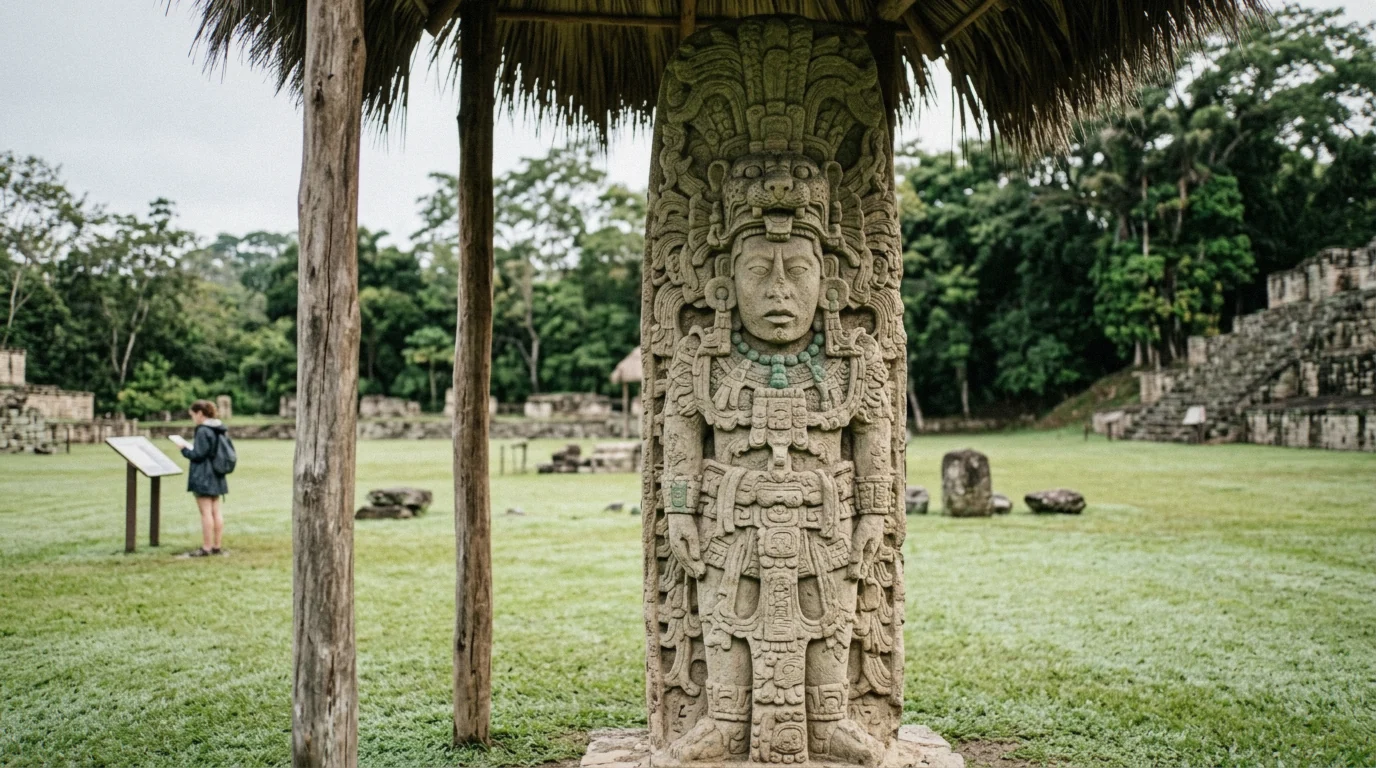
A ruler portrait on the Great Plaza.
Copán Ruins Entrance Fees and Opening Hours
Entry is ticketed per site by the Honduran Institute of Anthropology and History, and foreign visitors pay in US dollars or the lempira equivalent.
What Each Ticket Costs
The table below compares the main tickets at Copán across the three visitor categories used by the official ticketing page. The key point for most travellers is that the $20 park ticket is a combined one: it covers both the main Archaeological Park and the Las Sepulturas residential group, which is linked to the main site by a stone causeway. The tunnels, the Museum of Maya Sculpture and the town's Regional Museum are charged separately, so a full day with every add-on costs more than the headline fee.
Children under 6 enter free.
| Ticket | Foreign visitors | Central Americans | Hondurans |
|---|---|---|---|
| Archaeological Park plus Las Sepulturas (combined) | $20 | $10 | L 100 (reduced L 50 seniors and disabilities, L 40 verified students) |
| Tunnels under the Acropolis | $15 | $15 | L 50 |
| Museum of Maya Sculpture | $10 | $5 | Not published |
| Regional Museum of Archaeology (town) | $5 | $5 | Not published |
The Tunnel Fee: One Ticket or Two?
This is the one fee worth flagging before you budget. The official ticketing page lists a single 'Tunnels' category at $15 without splitting out the two known tunnels, Rosalila and Los Jaguares. Several travel blogs, however, describe them as two separate tunnels each charged $15, which would make seeing both cost $30.
The official price list does not settle the question. The safe approach is to budget for the possibility of paying per tunnel and ask at the ticket window when you buy.
- Official page: one 'Tunnels' fee of $15
- Some travel blogs: $15 each for Rosalila and Los Jaguares
- No official confirmation either way
Opening Hours
The archaeological park operates daily, and the official ticketing page gives the hours as 8:00 a.m. to 4:00 p.m. Some third-party sources state 8:00 a.m. to 5:00 p.m., so sources differ. The official figure is the safer one to plan around, and it is worth confirming your timing on arrival or the day before.
The Regional Museum of Archaeology in town is reported to open 9:00 a.m. to 5:00 p.m. daily, though that comes from a secondary listing rather than an official source. Arriving near the 8:00 a.m. opening gives you the coolest air and the quietest paths before tour groups from Guatemala and San Pedro Sula arrive.
| Site | Hours |
|---|---|
| Archaeological Park | 8:00 a.m. to 4:00 p.m. daily (official) |
| Regional Museum of Archaeology | 9:00 a.m. to 5:00 p.m. daily (reported) |
Sources: Sitio Maya de Copan, official IHAH ticketing page, EventSeeker
What to See at Copán, Structure by Structure
Copán rewards slow walking more than box-ticking. These are the structures that justify the trip.
Great Plaza and the Stelae
The Great Plaza, sometimes called the Monument Plaza, sits on the north side of the Main Group and holds the greatest concentration of carved stelae anywhere at the site. These tall stone shafts portray individual kings in full regalia, and Copán's sculptors worked at a depth and detail few other Maya cities attempted. Give yourself time to circle the monuments rather than viewing them from the path, because the faces, sandals and glyph bands reward close looking.
This plaza is usually where the 2-3 hour core visit begins.
- Highest concentration of carved stelae at the site
- Portrait monuments of individual Copán kings
Hieroglyphic Stairway
The Hieroglyphic Stairway climbs the west side of Structure 10L-26 and is the single most famous monument at Copán. It is 10 meters (33 ft) wide, has 62 steps, and takes its name from the glyph blocks set into the risers, which together form the longest known Maya hieroglyphic text. How many glyphs that is depends on who you ask.
Published counts range from more than 1,250 to roughly 2,200 glyphs. No single authoritative modern count is published, so it is fairest to say the stairway carries well over a thousand glyphs and likely more than 2,000. It was first built in AD 710, then removed, doubled in length and reinstalled in AD 755.
- 62 steps, 10 meters (33 ft) wide
- Longest known Maya hieroglyphic text
- Glyph counts reported between roughly 1,250 and 2,200 depending on the source
- First built AD 710, rebuilt and doubled AD 755
Acropolis, Temple 16 and Rosalila
The Acropolis is the royal complex at the heart of the city, made up of two enclosed plazas, the West Court and the East Court. Its tallest feature, Structure 10L-16 or Temple 16, hides one of Copán's great discoveries. During tunneling under the final temple, archaeologist Ricardo Agurcia found the Rosalila phase almost fully intact, a temple built during the reign of the 10th ruler, Moon Jaguar.
Its hieroglyphic dedicatory step carries a date deciphered as AD 571. You reach Rosalila through the paid tunnel, and a full-size replica stands in the Sculpture Museum if you skip it. The founder's tomb, K'inich Yax K'uk' Mo' himself, was found beneath this same structure in 1995 by a team led by Robert Sharer and David Sedat.
Temple 22
Temple 22 was built to celebrate the 13th ruler Uaxaclajuun Ub'aah K'awiil's first K'atun in power in AD 715, and its hieroglyphic step reads 'I completed my K'atun'. Its most photographed feature is the interior doorway, framed by an elaborate mask of the mountain god Witz, with the doorway forming the mouth of the mountain itself. It is a compact stop but one of the best examples of Copán's architectural sculpture still in place.
Ballcourt and the Macaw Deity
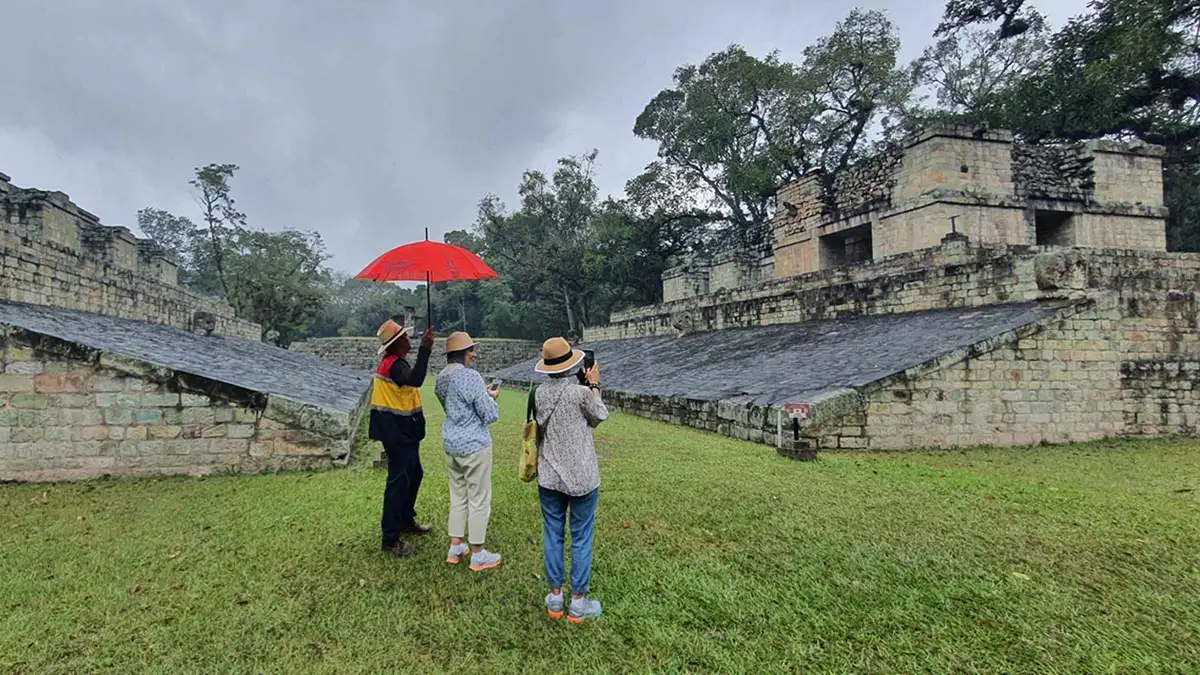
The Ballcourt was rebuilt a third time under Uaxaclajuun Ub'aah K'awiil and dedicated to the great macaw deity. Its flanking buildings carried 16 mosaic macaw sculptures, and its completion is inscribed as 6 January 738, months before that same king was captured and beheaded by Quirigua. Scarlet macaws run deep in Copán's identity: even the first ballcourt, built by the second ruler K'inich Popol Hol, was decorated with images of the bird.
The scarlet macaw remains the emblem of the site today, and you can often see the birds themselves around the park entrance.
- Third rebuild dedicated to the macaw deity
- 16 mosaic macaw sculptures on the flanking buildings
- Completion inscribed as 6 January 738
Las Sepulturas
Las Sepulturas is the residential district, linked to the Main Group by a stone causeway known as a sacbe. It is mostly elite residences, with carved stone benches and tombs, and by AD 800 it consisted of about 50 buildings around 7 courtyards. It is included in the same $20 ticket as the main park, so there is no extra cost.
It is quieter than the Main Group and shows how the non-royal elite lived, which makes a useful contrast after the monuments.
- Included in the main park ticket
- About 50 buildings around 7 courtyards by AD 800
- Reached from the Main Group by a stone causeway
Museum of Maya Sculpture
The Museum of Maya Sculpture charges $10 for foreign visitors and houses the great pieces removed from the monuments for their protection, including a full-scale replica of the Rosalila temple, brightly painted as the original would have looked. If you do not take the tunnel, the replica is how most visitors meet Rosalila. If you do take the tunnel, the museum still adds context, since the originals of many relief fragments on the stairway and temples now live here.
It fits naturally at the end of a site visit.
A Short History of the Copán Dynasty
Copán is best understood as the story of a single royal house that lasted four centuries and then lost everything.
The Founder and the Sixteen Kings
The dynasty began when a warrior called K'uk' Mo' Ajaw arrived and took the throne in AD 426, adopting the name K'inich Yax K'uk' Mo'. Altar Q, the square carved altar in the West Court, places the founding in AD 426-427 and shows the full line of succession. Sixteen kings ruled for roughly four centuries, plus a probable seventeenth pretender named Ukit Took' who was never depicted on Altar Q. At its Late Classic peak the kingdom of Copan had a population of at least 20,000 people, with the urban core alone estimated at 6,000 to 9,000 inhabitants.
The city's likely ancient name was Oxwitik, meaning 'Three Witiks', though what a witik was is no longer understood.
| Date | Event |
|---|---|
| AD 426-427 | K'inich Yax K'uk' Mo' founds the dynasty |
| AD 571 | Dedication date deciphered on the Rosalila temple's hieroglyphic step |
| AD 710 | First version of the Hieroglyphic Stairway built |
| AD 715 | Temple 22 built for the 13th ruler's first K'atun |
| AD 738 | 13th king captured and beheaded by Quirigua, 17-year monument hiatus follows |
| AD 755 | Stairway doubled in length and reinstalled |
| AD 776 | Altar Q dedicated by the 16th ruler, Yax Pasaj Chan Yopaat |
| Early 10th century | City abandoned as a political center |
The Disaster of AD 738
In AD 738 Uaxaclajuun Ub'aah K'awiil, the 13th king, was captured and beheaded by K'ak' Tiliw Chan Yopaat, the king of Quirigua, a state that had been Copan's vassal. The defeat triggered a 17-year hiatus in monument-building at Copan, and the kingdom never fully recovered its dominance. Older tourist literature calls this king '18 Rabbit', but current scholarship uses the reading Uaxaclajuun Ub'aah K'awiil.
Abandonment and Rediscovery
The city was abandoned as a political center in the early 10th century, and by the time the Spanish arrived in the 16th century the ceremonial core had long been deserted, with only a few farming hamlets left in the valley. Why it was abandoned is not settled, though the population collapse was severe, falling to under 5,000 by the 8th and 9th centuries from a peak above 20,000. The first written mention after the conquest is a letter dated 8 March 1576 by Diego Garcia de Palacio to King Philip II of Spain.
In the 19th century the site drew explorers again, and John Lloyd Stephens and Frederick Catherwood published maps and drawings in Stephens' 1841 book 'Incidents of Travel in Central America, Chiapas and Yucatan', which brought Copán to the wider world. UNESCO inscribed the site as a World Heritage Site in 1980, and the Honduran government separately designated it a cultural monument in 1982.
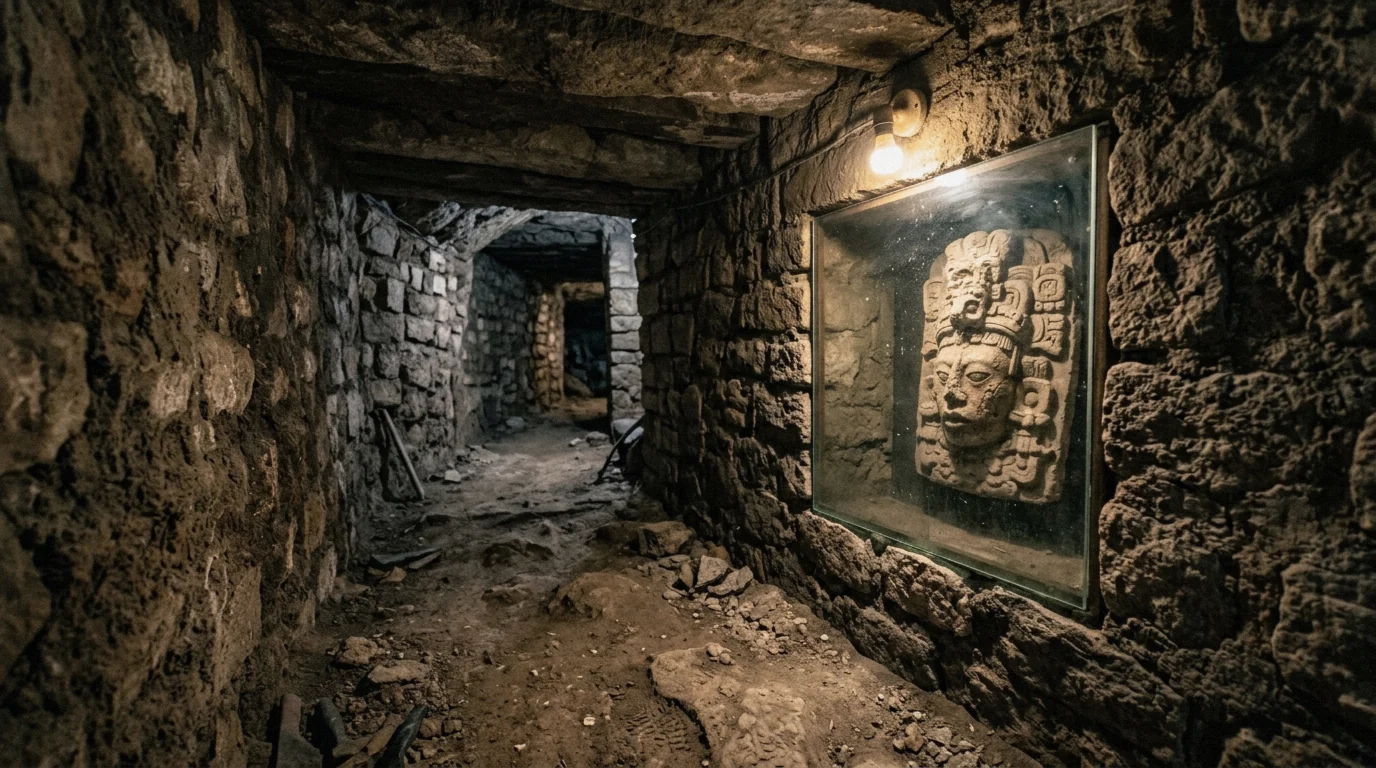
The tunnels run through earlier temples.
How Much Time Copán Needs
The honest answer depends entirely on whether you add the tunnels and museums.
The Short Visit and the Full Day
Most visitors need about 2-3 hours to cover the Great Plaza, Acropolis and ballcourt at a normal pace. Adding a tunnel and the Sculpture Museum extends the visit toward half a day. The guided tours from San Pedro Sula are built around different lengths of stay.
One gives you about 6 hours at the site, which comfortably fits the core, a tunnel, both museums and Las Sepulturas if you move steadily. The other allows about 4 hours at the ruins, enough for the core site and one or two add-ons but tighter. Both run 14 or more hours door to door because of the drive.
| Visit type | Time at the site | What fits |
|---|---|---|
| Core visit | 2-3 hours | Great Plaza, Acropolis, ballcourt |
| Tour with about 4 hours | About 4 hours | Core site plus one or two extras |
| Tour with about 6 hours | About 6 hours | Core site, tunnels, museums, Las Sepulturas |
| Full site on our six-hour itinerary page | Around half a day or more | Everything above at a relaxed pace |
If You Are Short on Time
If 2-3 hours is all you have, skip the tunnels and spend it in the Great Plaza and around the Hieroglyphic Stairway, then walk the ballcourt and climb the viewpoints over the Acropolis. See the Rosalila replica in the Sculpture Museum only if time remains, because the plaza monuments are the pieces you cannot substitute.
Best Time to Visit Copán
Copán's climate splits into a dry season and a rainy season, and the trade-off is crowds versus green landscape.
Dry Season, November to April
The generally recommended visiting window is November through April, the dry season. December to February are the coolest and busiest months, with average temperatures around 27C (80F) in January and February. If you want pleasant walking weather and do not mind sharing the plaza, this is the window to aim for.
- Dry season: November to April
- Coolest and busiest: December to February
- January-February average around 27C (80F)
Rainy Season, May to November
The rainy season runs roughly May through November, with the heaviest rainfall in May, June and July. June averages about 286mm of rain. Even in the wet months it usually does not rain all day, with showers concentrated in the late afternoon, so a morning visit still works.
The upside is fewer people and a greener valley.
Copán Ruins Dos and Don'ts
Simple habits make the difference between a comfortable day at Copán and a hard one.
Do
- Do wear shoes with grip, because the stone steps and causeways are worn smooth and slip when wet.
- Do bring sun protection and water, since the Great Plaza has little shade and the site sits in an open valley.
- Do carry cash for the tunnel, museum and town museum tickets, because those are charged separately from the park entrance a guided tour may already cover.
- Do arrive at or near the 8:00 a.m. opening for cooler air and quieter paths.
- Do walk out to Las Sepulturas, since it is included in your $20 ticket and rarely busy.
Don't
- Don't plan your day around a 5:00 p.m. closing, because the official hours are 8:00 a.m. to 4:00 p.m. and some third-party sources that say otherwise conflict.
- Don't budget a single $15 tunnel fee without a backup, because it is not officially clear whether one ticket covers both tunnels or only one.
- Don't touch or climb on the carved stelae and glyph blocks, both for their protection and because the rules at a World Heritage site are strict.
- Don't leave the plaza carvings to the end of your visit, since the stelae are the reason most people come and energy fades in the heat.
- Don't rely on card payment everywhere at the site, as no official source confirms card acceptance for every separate ticket window.
Guided Copán Day Trips from San Pedro Sula
Both tours below are run by the same operator and both include hotel pickup and drop-off in San Pedro Sula and the Copán park entrance fee, at $295 each. What they do not include matters: the tunnels, the Sculpture Museum and a local guide inside the ruins are paid extras on both, and neither includes lunch. The main difference is time at the site, about 6 hours versus about 4, and total day length.
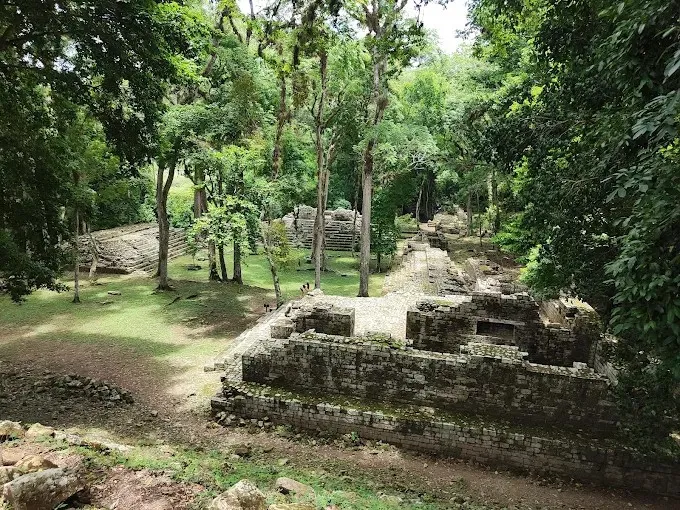
From San Pedro Sula: Mayan Ruins of Copán Day Trip (6 Hours at the Site)
The most-reviewed Copán day: hotel pickup, a coffee break at Welchez Cafe in La Entrada, the ruins entrance fee and about six hours at the archaeological site. The museum, tunnels, local guide and lunch are extras.
- Cancellation
- Free cancellation 24h
- Operator
- iCatracho Tours
From San Pedro Sula: Mayan Ruins of Copán Day Trip
The longest Copán day on the list: 14 hours door to door, pickup from 21 hotels at 06:00, the ruins entrance and about four hours at the site. The museum, tunnels and a local guide are optional extras, and breakfast and lunch are at your own cost.
- Cancellation
- Free cancellation 24h
- Operator
- iCatracho Tours
Watch Before You Go
A third-party video, embedded from YouTube. We have no relationship with its creator.
Copán Ruins: Questions Before You Go
Are the Copán ruins worth visiting?
For most travellers in Honduras, yes. Copán holds the longest known Maya hieroglyphic text on its stairway, portrait stelae of exceptional carving quality, and the buried Rosalila temple, and it has UNESCO World Heritage status since 1980. If you are based in San Pedro Sula, a guided day makes it easy, so compare the Copán day trips before deciding.
What is the significance of the Copán ruins?
Copán was the capital of a kingdom ruled by a single dynasty of sixteen kings from AD 426-427, and its sculpture, especially the Hieroglyphic Stairway with its long glyph text and the 16 kings carved on Altar Q, is among the finest the Maya produced. You can read the full story in our history section.
Why was Copán abandoned?
The city was abandoned as a political center in the early 10th century, and its population had already collapsed from a peak of at least 20,000 to under 5,000 by the 8th and 9th centuries. The pack behind this guide records the decline but no single confirmed cause. By the Spanish arrival in the 16th century only a few farming hamlets remained. See the site yourself on a day trip from San Pedro Sula.
What are the pyramids in Copán known for?
Temple 16, the Acropolis's main pyramid, is known for hiding the almost fully intact Rosalila temple, found by tunneling, and the tomb of the dynasty's founder, discovered in 1995. Temple 22 is known for its doorway framed as the mouth of the mountain god Witz. Both sit inside the park covered by the $20 combined entrance ticket.
How much are Copán ruins tickets?
Foreign visitors pay $20 for the combined Archaeological Park and Las Sepulturas ticket, $15 for the tunnels, $10 for the Museum of Maya Sculpture and $5 for the town's Regional Museum. It is not officially clear whether the tunnel fee covers one tunnel or both. The full breakdown is in our fees and hours section.
How much time do you need at Copán?
Plan 2-3 hours for the Great Plaza, Acropolis and ballcourt, and toward half a day if you add a tunnel and the Sculpture Museum. Guided days from San Pedro Sula allow about 4 to 6 hours at the site, and one is detailed hour by hour on our six-hour itinerary page.